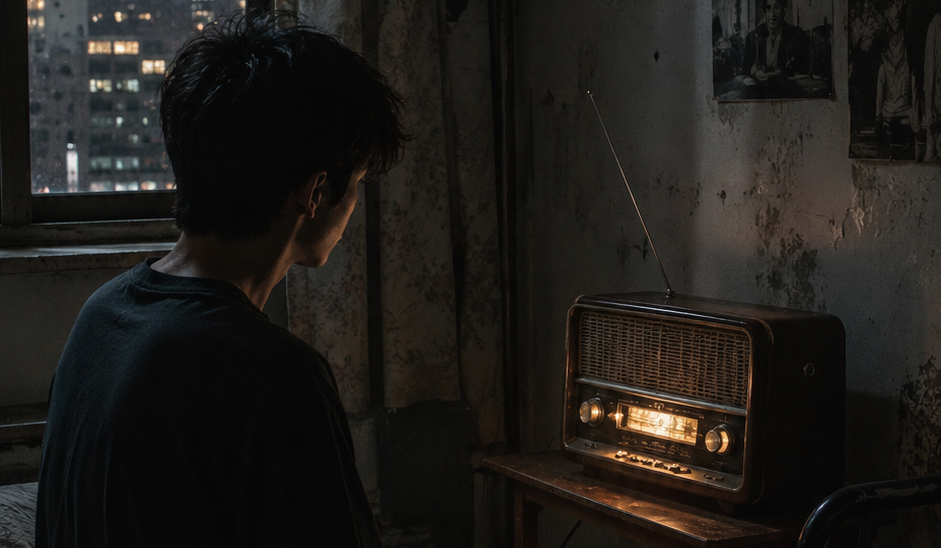
At 3:07 every morning, the old radio in the abandoned apartment would turn itself on, even though the electricity had been cut for months. The landlord blamed faulty wiring, but the boy knew better. That was the exact time his sister used to come home from work. After moving into her apartment following her death, he began living inside the silence she left behind. People told him to move on, to leave the place, to accept what had happened—but none of them understood what it meant to lose the only person who made life feel normal.
Every night, he sat on her bed and listened to the static until it shifted—sometimes into fragments of her favorite song, sometimes into something that felt almost like breathing on the other end of a line. At first, he convinced himself it was grief playing tricks on him. But then one night, the radio changed. The static cracked open into a voice.
“You’re still there, aren’t you?”
He froze. The voice was hers. Or something indistinguishable from her. “Lena…?” he whispered, his throat tightening. The radio immediately went silent, leaving the room heavier than before.
The next morning, he searched every station, every frequency, trying to recreate what he had heard. Nothing came through except normal noise. Days passed like that—until a plain envelope appeared in the mailbox. No name, no return address. Inside was an old cassette tape and a handwritten note: If you’re hearing her, you’re on the right frequency.
Shaking, he found an old tape player and pressed play.
At first, there was only static. Then her voice returned—clear, fragile, and impossibly close.
“If you’re listening to this, I didn’t die the way they told you.”
His breath stopped.
“I was trying to call you that night. Something happened in the tunnel. I recorded this in case they never found me.”
She spoke in details only they shared—small memories, private moments, things no one else could possibly know. But as the recording continued, her voice changed. It grew slower. Heavier.
“There’s something else,” she whispered. “I’m not the only one who’s been trying to reach you.”
The tape suddenly cut out.
That night, the clock crept toward 3:07.
He sat in front of the radio, waiting. When the minute arrived, it turned on by itself again—but this time, it wasn’t her voice that came through.
It was his own.
Speaking words he didn’t remember saying, describing the accident in perfect detail… from a perspective he had never lived.
The room went cold.
And just before the signal died completely, a final sentence slipped through the static:
“You weren’t listening to her frequency… she was listening to yours.”